 The Duke
 Security
 The Network Was Never the Boundary: What mTLS Actually Buys Service-to-Service Traffic
Mutual TLS — mTLS — is TLS with the authentication running in both directions. In ordinary TLS, the client checks the server’s certificate and trusts it’s talking to the real thing; the server doesn’t check anything back. In mTLS, the server checks the client too: it demands a certificate, verifies the chain against a CA it trusts, and confirms the client’s identity, all before the actual request gets processed. No valid client certificate, no connection — regardless of which network the call came from.
That second check matters more than it sounds like it should, because of what most internal systems do without it. Without mTLS, “reachable” and “trusted” are usually the same thing: if a request can get to Service B’s port at all, Service B mostly assumes it’s legitimate, because reaching it means being inside the same VPC or cluster. That’s a weaker guarantee than it feels like — a forgotten staging job, a compromised sidecar in an unrelated app, a contractor’s laptop still sitting on the VPN months after the contract ended can all route a packet to that port just as easily as the real caller can. Service B has no way to tell any of them apart, because it never asked who was calling. It only checked that the request arrived.
mTLS closes exactly that gap. It turns “reachable” into “who are you, actually,” and enforces the answer on every single connection.
What actually happens on the wire
Put Service A and Service B on either end of the handshake: A presents its certificate, B verifies it against a trusted CA and confirms A’s identity, and only then does A’s request get processed.
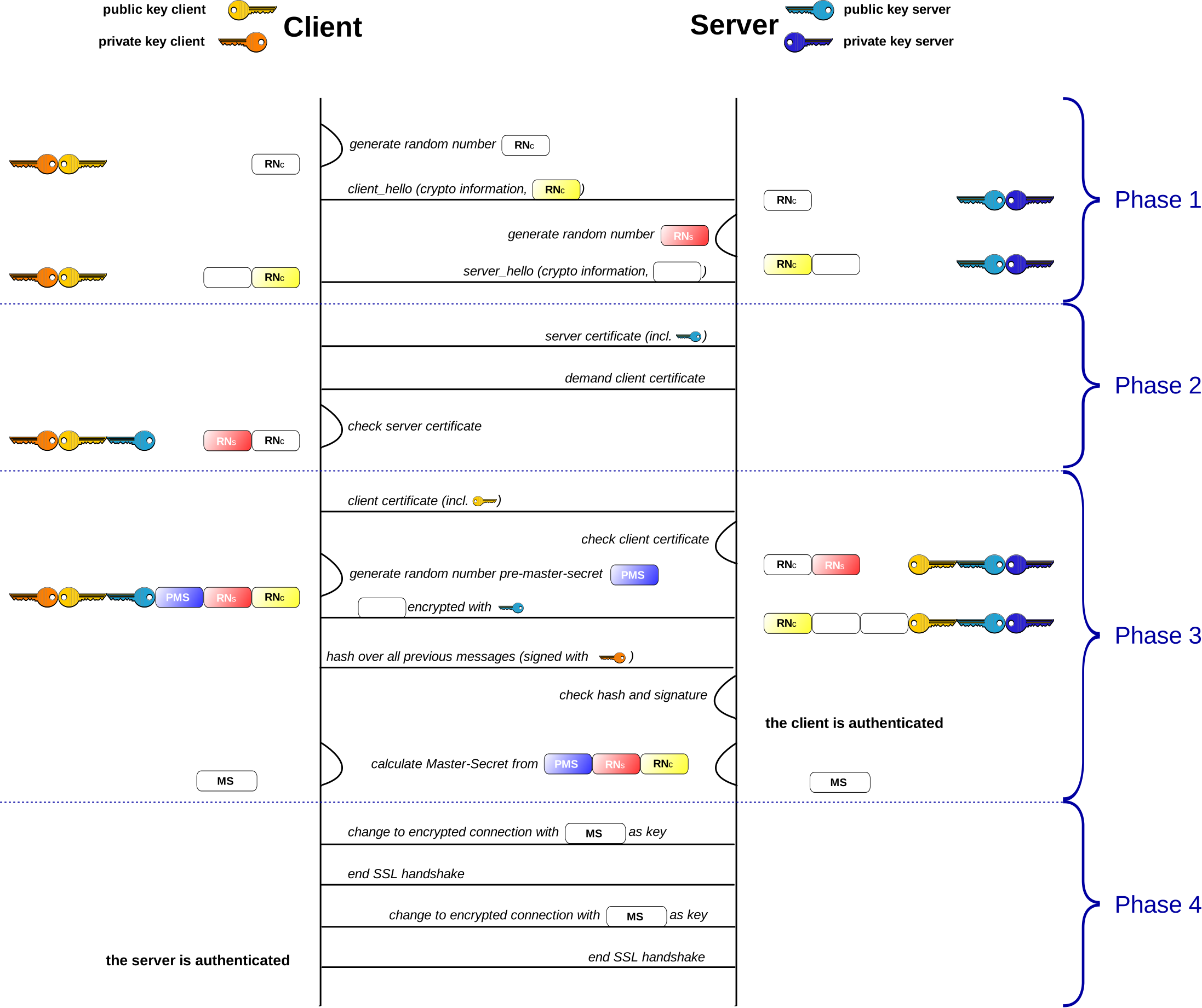
That’s the whole pitch for running mTLS between services: you stop trusting the network and start trusting an identity you actually issued and control. It’s also worth saying plainly what mTLS doesn’t do — it tells Service B who’s calling. It says nothing about what that caller is allowed to do once it’s in the door. That’s a separate job, handled by policy, not by the handshake.
When it’s worth it, and when it’s just cost
mTLS earns its keep once a system has enough moving parts that “it’s on the internal network” stops meaning anything — dozens of services, teams that don’t all know each other’s traffic patterns, or an actual compliance requirement to prove who talked to whom. At that scale, an explicit identity per service is worth more than an implicit one per subnet.
It’s premature somewhere else: a handful of services, low blast radius, and — this is the part that actually matters — no automated way to issue, rotate, and revoke certificates yet. Adopting mTLS without that automation doesn’t buy you security so much as it buys you a very specific, self-inflicted outage, on a schedule you don’t control. If most of your risky traffic is actually external — partners, enterprise customers hitting an API — a gateway that terminates mTLS at the edge is usually a better fit than trying to hand every third party a client certificate.
Where it actually runs
Three places, roughly in order of how much application code has to change:
- At a gateway, between external clients and your edge — good for a smaller number of well-known callers, like enterprise partners.
- Service to service, directly, where each service terminates its own TLS and checks the caller’s certificate itself — simple to reason about, but every service now owns crypto code and cert config.
- In a service mesh, where a sidecar proxy next to each service handles the handshake and the policy, and the application mostly doesn’t know mTLS is happening at all.
For anything beyond a handful of services, the mesh model tends to win on operational grounds, precisely because it centralizes the one thing you really don’t want copy-pasted forty times: certificate handling.
The performance cost
mTLS costs more per connection than plain TLS, because there’s an extra certificate to check on every handshake. Verifying it burns CPU, and the handshake itself takes longer end to end. The place this actually bites is short-lived connections — a service that opens a fresh TCP connection for every single request pays the full handshake cost every single time, and p95 latency creeps up in a way that has nothing to do with your application logic.
The fix is almost entirely about not doing handshakes more often than you have to: keep connections alive with keepalive and pooling, use session resumption if your TLS stack supports it, and stop treating “one connection per request” as free. None of this is exotic — it’s the same advice you’d give for plain TLS, just with a slightly less forgiving penalty for ignoring it.
Certificate lifecycle: the part that decides the outcome
Everything above is the mechanism. This is the operational half, and it’s the one that actually determines whether mTLS works well or badly in practice: certificate lifecycle. Who issues certificates and what identity goes in them. How a workload gets its certificate in the first place. How rotation happens before expiry, without a rollout that kills connections in bulk. How you revoke fast when a key’s been compromised. How you roll the trust bundle itself forward when a CA changes, without one side updating before the other and breaking every handshake between them.
It’s worth taking seriously because the same fail-closed design that makes mTLS work is not limited to tidy internal services — it’s just as fail-closed on hardware that was never meant to be a cautionary tale. On December 6, 2018, a software certificate quietly expired inside Ericsson’s SGSN-MME equipment, the gear that manages mobile data sessions for carriers worldwide. The equipment did exactly what it was built to do the moment it could no longer verify its own certificate: it stopped. Roughly 32 million O2 customers in the UK and 40 million SoftBank customers in Japan lost mobile data that day, across 11 countries in total — not from an attack or a capacity problem, but from one certificate nobody rotated in time.
That wasn’t a certificate bug. It was a lifecycle bug wearing a certificate’s clothes. A service mesh with automatic sidecar-issued short-lived certificates — the model Istio ships with — exists specifically so that no single human has to remember an expiry date. mTLS at any real scale is a bet that you’ll build that automation before you need it, not after.
What actually breaks, and how to find it fast
The failure modes repeat: an expired certificate, clock drift between nodes making a valid certificate look invalid, a trust bundle that’s out of sync across clusters, a certificate’s identity not matching what policy expects, or client and server simply not sharing a cipher suite. When something breaks, the fastest triage isn’t clever — check whether it’s failing during the handshake or after, check whether it’s clustered by node or region or one specific service, and check expiry and clock sync first, because that’s the boring answer most of the time.
Seeing that quickly requires actually watching for it: handshake success and error rates per upstream, handshake latency (which tells you if it’s a network problem or a certificate problem), days-to-expiry on every identity that matters, and logs that say why a handshake failed, not just that it did. The goal, when something breaks at 2am, is answering three questions fast — where, who, why — instead of staring at a dashboard that says everything is up while nothing is actually working.
The tradeoff, plainly
mTLS replaces an implicit trust (this request reached me, so it’s probably fine) with an explicit one (this request proved who it is, so I’ll process it). That’s a real security improvement, and it’s why the pattern keeps showing up in zero-trust and service-mesh architectures. It also means you’re committing to run a certificate authority for your own infrastructure indefinitely — issuance, distribution, rotation, revocation, and trust bundle updates, all handled correctly, forever.
That second part isn’t optional overhead you can skip. Fail-closed authentication is the entire security benefit of mTLS; the tradeoff is that the same mechanism fails the same way when the certificate behind it is wrong, whether that’s one service or, as Ericsson found out, a continent’s worth of phones. Adopt mTLS once the lifecycle automation is solid enough to trust with that job — not before.


Reactions & discussion